Executive summary
A sale process is easier to control when the owner prepares the evidence before a buyer prices uncertainty. In a Canadian frozen-food, ready-to-eat or specialty-food manufacturer, buyer readiness reaches beyond a clean income statement. It includes sustainable earnings, working-capital needs, food-safety and traceability records, customer and supplier concentration, plant constraints, capex, management depth and a credible succession or transition plan.
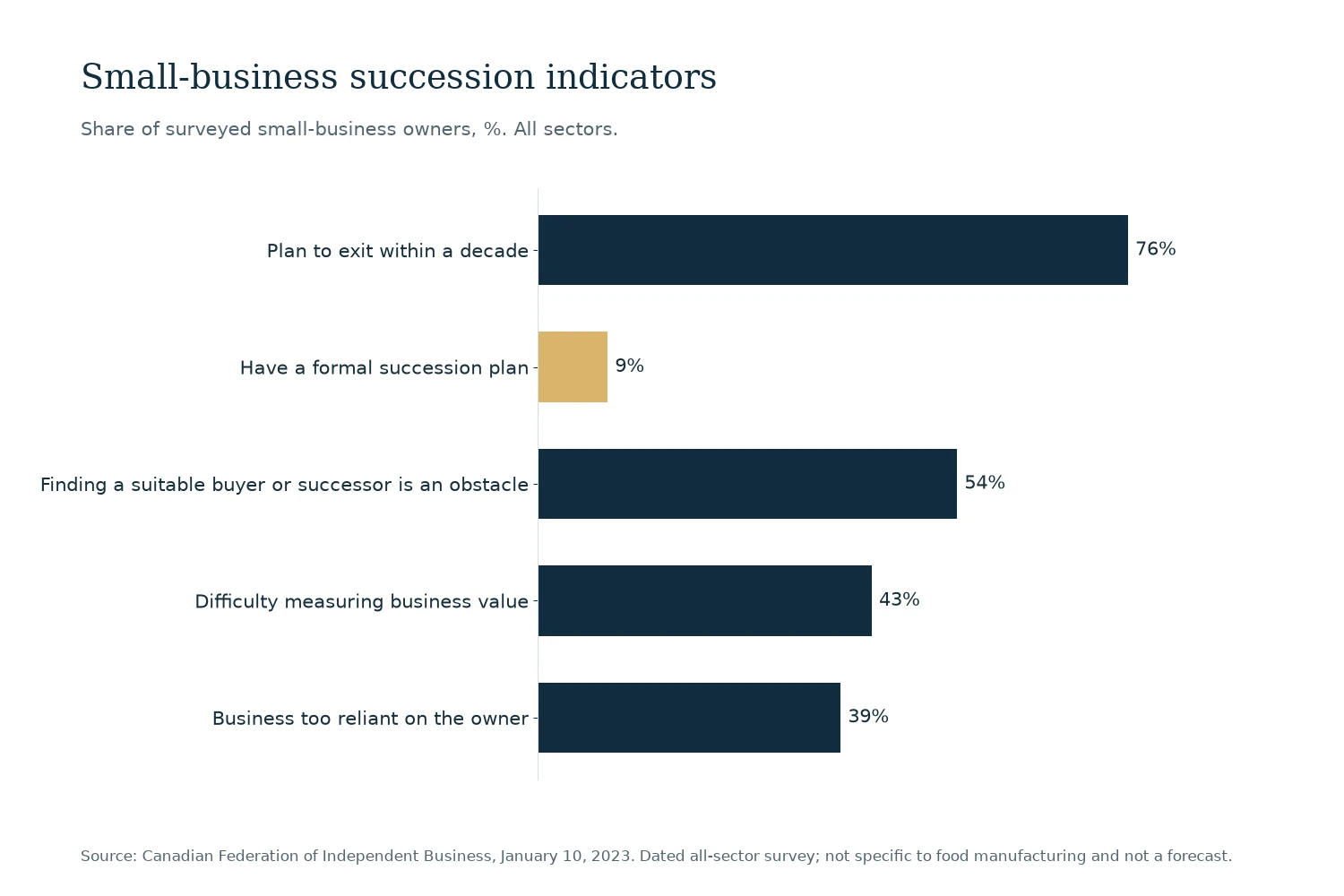
Succession is a market issue, but public succession statistics are not transaction forecasts. In a January 10, 2023 release, the Canadian Federation of Independent Business (CFIB) reported that 76% of small-business owners planned to exit within a decade, while only 9% had a formal succession plan. It also reported that 54% identified finding a suitable buyer or successor as an obstacle, 43% struggled to measure value and 39% said the business was too reliant on them for day-to-day operations. Those figures are an old, all-sector survey vintage. They are useful to explain why preparation matters, not to describe the current frozen-food market or predict sale outcomes.
This paper offers a practical preparation sequence: clarify the desired transition; make earnings reproducible; evidence the operating platform; reduce avoidable dependency; and expose risks in a controlled way. It does not promise a valuation, buyer, financing or closing.
1. Succession begins with an owner decision
Before assembling a buyer package, decide what a successful transition means. Is the objective a full exit, a staged transition, continued employment, protection of employees, Canadian ownership, a family transfer or a strategic combination? Timing, tax and legal consequences require appropriate professional advice. A buyer needs to understand what changes on closing, what the owner will continue to do and what happens if the transition takes longer than planned.
The CFIB release found that 90% of owners seeking to sell considered protecting employees important, while 84% valued the highest possible price and 84% selecting a buyer who would carry forward the way they do business. These are owner priorities, not evidence that a buyer will pay for them. They should be translated into transaction criteria, transition terms and a realistic operating plan.
MerchantBanker.ca’s public Transaction Readiness framework puts the paid Independent Review first: determine whether a credible pathway exists, identify gaps and select the next decision. The review decision vocabulary—Proceed, Prepare, Restructure, Defer or Stop—keeps the owner from confusing a desire to sell with readiness to sell.
2. Make earnings quality traceable
Start with reported results that reconcile to the accounts, tax filings and bank activity. Then build an adjustment bridge. For every proposed add-back, show the amount, period, explanation, supporting evidence and whether the cost truly disappears after closing. Owner compensation may need to be reset to the cost of a replacement role. Related-party rent may need to reflect market terms. Recurring repairs, recruitment, customer disputes and quality costs are not automatically exceptional.
Keep future improvements separate. Automation, purchasing savings, a new retailer, additional shifts and distribution expansion belong in an assumptions-based forecast with investment, timing and execution risk. They should not be silently added to historical EBITDA. Even supported EBITDA is not cash available to an owner: recurring maintenance capex, taxes, inventory, receivables, debt service and transition costs still matter.
A buyer will also test revenue quality. Reconcile sales and gross margin by customer, product and channel. Identify seasonal, project-based, private-label, co-pack and repeat demand. Explain rebates, returns, spoilage, freight and customer-specific production burdens. A concentrated customer with a contract that can be cancelled or renegotiated is different from diversified repeat demand, even if both appear as revenue in the ledger.
3. Prove the plant can transfer and scale
A buyer needs more than a rated line capacity or an unused shift. Show actual throughput, downtime, yield, sanitation, changeovers, labour availability, packaging, refrigeration, freezer space, warehousing and dispatch. List equipment age, maintenance history and the capex required over 24–36 months. Separate compliance and maintenance from optional capacity expansion.
Food safety is part of buyer readiness, not a footnote. The CFIA describes a preventive control plan as a written document showing how hazards are identified and controlled. For relevant licensed interprovincial manufacturing and processing, a written plan is generally required; CFIA’s guidance also addresses records, corrective action, complaints, recalls, labelling and traceability. Traceability rules require applicable businesses to track food forward to the immediate customer and back to the immediate supplier. Applicability depends on the actual product, activity and market. Organize licences, audit findings, corrective actions, environmental or product testing, recall exercises, lot records and customer requirements so a qualified reviewer can follow the evidence.
The people plan matters just as much. Identify decisions held by the owner: key accounts, production scheduling, purchasing, quality escalation, pricing, hiring and supplier relationships. Name the accountable successor for each role, document procedures and set a transition timetable. A business that cannot operate without the seller may still be valuable, but the risk must be visible and addressed rather than hidden in an adjusted earnings number.
4. Prepare buyer-ready information without over-marketing
A disciplined data room normally begins with corporate and ownership records, financial statements, tax filings, bank debt, sales and gross-margin schedules, inventory ageing, customer and supplier information, contracts, leases, licences, food-safety records, employee and management information, equipment and capex schedules, insurance, litigation and environmental matters. Legal counsel should determine what can be shared, when and under what confidentiality protections.
A CIM can help present the company, transaction rationale, operating evidence, financial analysis, risks, capital structure and proposed pathway—but only when it is an expressly scoped, signed deliverable. It is not a securities prospectus, an assurance of financing or a substitute for diligence. It is not a standalone magic document. Full buy-side or sell-side advisory, outreach, negotiation and transaction execution require a separately signed mandate and clear responsibilities.
Fictional illustrative case (not a MerchantBanker.ca client result)
Assume a founder-owned frozen-meal manufacturer has reported EBITDA of $900,000. Management proposes adding back $80,000 of a one-time plant incident, but the owner currently performs sales, scheduling and procurement for below-market compensation. A replacement operations/commercial structure is assumed to cost $140,000 annually. A related-party lease is $30,000 below the terms expected after closing. The illustrative normalized EBITDA bridge is therefore $900,000 + $80,000 − $140,000 − $30,000 = $810,000, subject to verification. The numbers are assumptions, not a market benchmark or client result.
The owner also presents a new grocery listing as immediate growth. Buyer readiness requires the listing terms, launch timing, promotional allowances, production schedule, working-capital requirement, returns exposure and evidence of repeat orders. Until verified, the listing remains a separate upside case, not historical earnings. The preparation decision may be Proceed, Prepare or Defer depending on the evidence. It may also show that a transition plan and plant capex must be completed before outreach.
How this fits MerchantBanker.ca
Transaction Readiness is the method. The paid Independent Review is the initial decision engagement. The Independent Review generates financial and operational analysis. Within the signed scope, Financial Analysis examines normalized earnings, working capital, cash conversion, value and capital-structure scenarios; Operational Assessment tests capacity, food safety, systems, management depth, capex and integration risk. A CIM follows only where expressly scoped and signed. It is a positioning and decision deliverable, not a prospectus, financing guarantee or representation.
A full sell-side advisory engagement—including buyer identification, outreach, negotiation and execution—requires a separately signed mandate. Capital raises are institutional-only and separately scoped. Legal, accounting, tax, regulatory and securities matters remain with appropriate qualified professionals. Preparation improves evidence; it cannot guarantee a price, financing or transaction.
Next step: request a confidential Transaction Readiness discussion to assess whether an Independent Review is appropriate.
Conclusion
A prepared sale is not a glossy story. It is a reproducible explanation of what the business earns, what cash it consumes, how it operates safely, who can run it after closing and which opportunities still require investment. Owners retain more control when those questions are answered before buyers, lenders and advisers discover the gaps for them.
Data notes and limitations
Data available as of November 12, 2026. Quarter labels identify this paper’s theme within MerchantBanker.ca’s 2026 four-part series; they do not represent a completed quarterly statistical report. Statistics are sector, survey or regulatory context, not company performance, valuation evidence or a forecast for an individual business. Some figures are preliminary, revised or marked “use with caution” by the source, and requirements can change. The illustrative case is fictional and is not a client result. The fourth quarter of 2026 is not complete; this paper is an outlook and preparation guide and presents no complete Q4 or full-year 2026 result.
Source notes
Public sources listed below, read with MerchantBanker.ca’s Transaction Readiness framework. Market statistics are context only. Data available as of November 12, 2026.
- CFIB, Over $2 trillion in business assets are at stake (January 10, 2023)
- CFIA, preventive control plan requirements
- CFIA, opening or expanding a food business
- CFIA traceability
General transaction education. Company-specific decisions require appropriate financial, legal and other professional review.