Executive thesis
“Spare capacity” is not an earnings forecast. It is a question that must be answered at the bottleneck, product, customer and cash-conversion level. A food-manufacturing acquisition creates a sustainable operating case only when additional output can be produced safely, sold at an acceptable contribution, staffed, financed and integrated without weakening current customers.
For frozen food, ready-to-eat, specialty and ethnic-food manufacturers, the bridge from capacity to earnings has several links: a reliable order, an available production window, labour and maintenance, ingredients and packaging, QA release, cold storage, working capital, delivery and collection. Break one link and theoretical capacity remains theoretical. The buyer’s job is to separate existing performance from improvements that require investment or execution.
What the data does—and does not—say
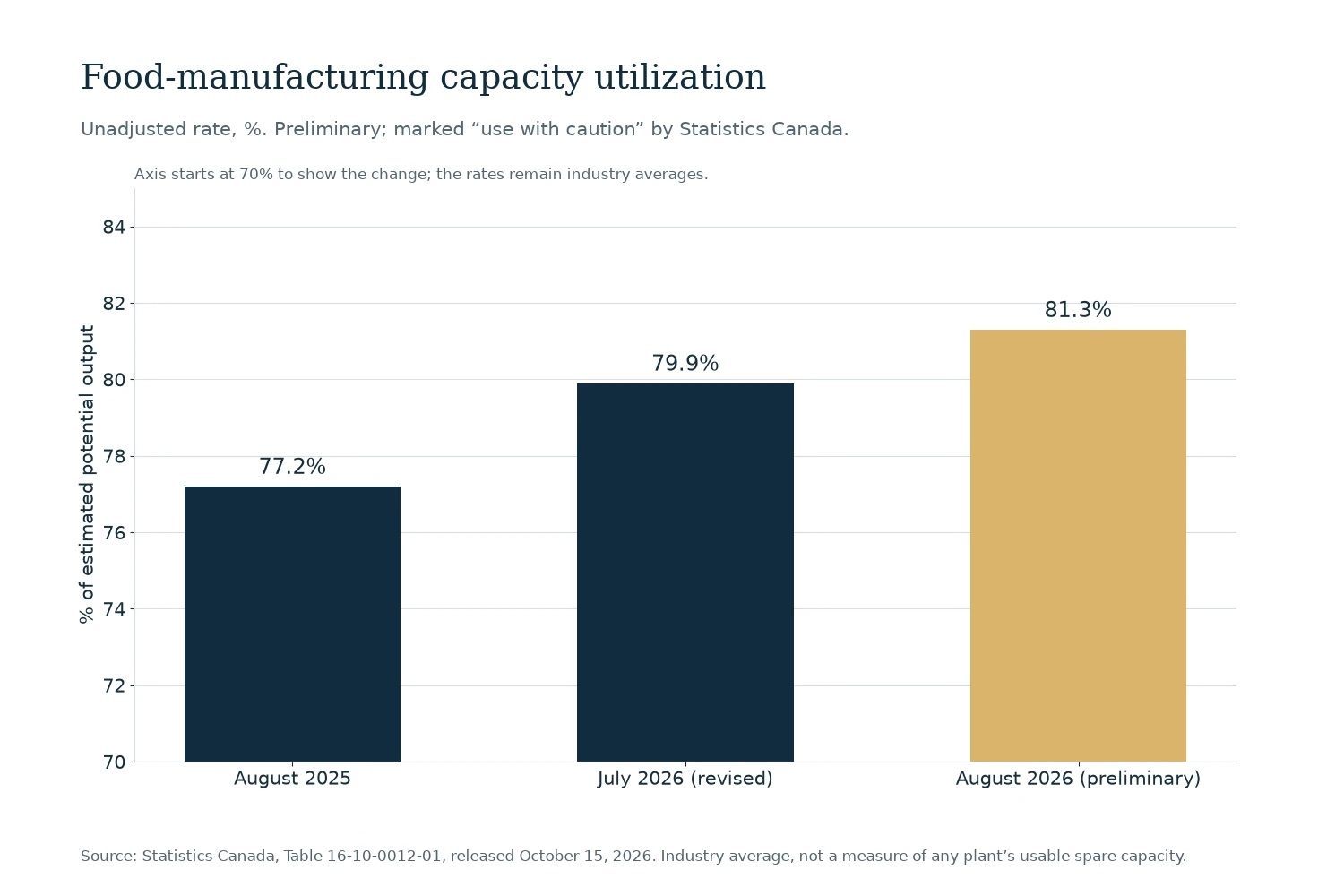
Statistics Canada recorded 81.3% food-manufacturing capacity utilization in August 2026, unadjusted and preliminary, marked “use with caution.” It was 79.9% in July 2026 and 77.2% in August 2025. The industry series is useful context for asking whether plants have room to grow; it does not measure a target’s available hours, bottleneck or incremental margin. Statistics Canada, manufacturing capacity utilization, August 2026.
The same month, food-manufacturing sales were $13.835 billion seasonally adjusted in current dollars, flat month over month and 6.4% above August 2025. Current-dollar sales combine volume and price effects and cover the full food-manufacturing subsector. They are not an acquisition forecast and should not be converted into a target revenue growth assumption. Statistics Canada, Monthly Survey of Manufacturing, August 2026.
AAFC reports that the 2024 food and beverage processing industry had $173.4 billion of sales of goods manufactured, employed 318,400 Canadians and supplied approximately 80% of processed food and beverages available in Canada. The scale supports an operating thesis; it does not prove that a particular line can run a second shift or that an acquisition will produce synergies. AAFC industry overview.
1. Define the constraint, not the percentage
A plant may report 70% average utilization while the freezer, allergen changeover, packaging machine, sanitation window, skilled operator or dock schedule is at 95%. Conversely, an apparently open line may be constrained by QA release, maintenance or cold storage. Measure current, peak and theoretical capacity by product family, line, shift, day and bottleneck. Record planned and unplanned downtime, changeover, sanitation, yield loss and order-fill performance.
2. Prove the demand
Incremental production should be tied to purchase orders, customer forecasts, qualified pipeline, contract terms or a tested channel plan. Private-label and co-pack work can add volume but may carry customer concentration, margin pressure, formula ownership and service-level risk. A buyer should ask whether the proposed customer will pay for setup, tooling, validation, packaging minimums and working-capital timing.
3. Calculate contribution, not revenue
The right unit is incremental contribution after ingredients, packaging, direct labour, freight, trade spend, rebates, spoilage, changeover and additional QA. A low-margin SKU can consume the shift that a higher-contribution product needs. SKU rationalization may increase sustainable earnings even when reported revenue declines. The analysis should show customer and product contribution separately from gross sales and reported EBITDA.
4. Include the operating investment
A second shift may require supervisors, training, maintenance coverage, sanitation, QA and employee retention. Automation requires installation, validation, downtime, training, spare parts and working capital. Freezer expansion can require refrigeration, energy, racking, fire protection and environmental approvals. The investment case must show timing, cash outlay, ramp-up and downside—not only a payback headline.
5. Fund the cash conversion cycle
Growth can consume cash before it creates EBITDA. Raw materials and packaging may be purchased before production; finished goods may sit in cold storage; retailers may deduct or pay later; and seasonal builds may be necessary. Model inventory days, customer terms, supplier terms, spoilage, returns, promotions and the working-capital reserve after closing. The capital stack must leave the plant able to operate through the ramp.
6. Protect food safety and service
The Safe Food for Canadians framework makes food-safety readiness central to interprovincial growth. CFIA states that most businesses manufacturing, processing, packaging or labelling food for export or shipment across provincial or territorial borders need a licence and preventive controls; many need a written preventive control plan. More volume without traceability, allergen control, sanitation and release discipline increases—not reduces—transaction risk. CFIA preventive food-safety controls.
Turning the operating case into diligence
A buyer should request a capacity pack rather than accept a single utilization percentage. It should include line rates, production calendars, shift patterns, downtime logs, changeover and sanitation duration, yields, scrap/spoilage, labour hours, order fill, backlog, freezer and warehouse capacity, maintenance history, QA release timing and equipment age. Reconcile production data to sales and inventory movement. If management cannot explain the difference, the capacity case is not ready for underwriting.
Commercial diligence should map revenue by SKU, customer, channel, province and contract type. Reconcile invoiced revenue to net realized revenue after rebates, deductions, returns, listing fees and promotional support. Identify products that create production disruption or customer-specific packaging burdens. Stress-test the loss of the largest customer and the delay of the proposed new account.
Management diligence should identify who owns scheduling, procurement, quality, maintenance, customer service and finance. An owner who personally solves every production problem represents a transferability cost. The buyer should budget the permanent management structure and test whether the plant can operate during transition.
Financial diligence should separate four cases:
• Base case: existing run-rate performance, normalized for recurring costs and owner dependence.
• Committed case: volume or pricing supported by contracts, purchase orders or documented customer evidence.
• Execution case: additional contribution requiring identified labour, capital, systems and management actions.
• Upside case: uncommitted market expansion, policy benefit, export or synergy that is not paid for at closing.
This separation reduces the risk of capitalizing an aspiration as current EBITDA. It also improves financing discussions because lenders can see which cash flow is available today and which depends on execution.
Sustainable earnings after closing
The first 100 days should prioritize continuity over maximum output. Confirm food-safety controls, key employees, customer communications, supplier terms, maintenance and cash reporting. Install a weekly operating dashboard covering orders, schedule adherence, yield, waste, downtime, labour hours, changeover, service level, inventory age and cash. A buyer should be able to identify a variance before it becomes a quarter-end surprise.
Next, rank initiatives by contribution, cash requirement, execution risk and management capacity. A small packaging change or SKU reduction may be safer than a new line. A procurement improvement may fail if quality or supplier reliability deteriorates. Centralized accounting or logistics can be useful, but the integration plan must protect local plant knowledge and customer service.
Automation should be approved against a measurable constraint: labour hours, throughput, yield, quality, safety, waste or service. The model should show baseline, installed cost, training, downtime, ramp-up, maintenance and the range of outcomes. Government support may improve the economics of an approved project; it should not be required to make an otherwise weak acquisition service its debt.
Bolt-ons should wait until the platform’s reporting, management and cash controls work. A second business can bring a product, customer, geography or capability, but it also brings another inventory system, QA process, labour structure and customer promise. Apply the same capacity-to-earnings bridge to the bolt-on.
Fictional illustrative case — not an actual client result
A fictional Quebec frozen-meal plant reports 68% average line utilization and proposes a second shift that would add $4 million of annual revenue. A review of logs finds the main line is available, but the blast freezer and allergen sanitation window are the constraints. The new shift would require a supervisor, two trained operators, more QA coverage, additional packaging inventory and a working-capital facility. The proposed customer has expressed interest but has not committed a forecast or contract. The buyer therefore treats the $4 million as an execution case, not current EBITDA. The first decision is to validate the order, price the labour and capital, test freezer throughput, and run a measured pilot. The result is not presented as a client outcome; it is a fictional illustration of disciplined underwriting.
Confidential next step
A confidential Transaction Readiness Call can determine whether a proposed acquisition or operating-improvement thesis merits an Independent Review. MerchantBanker.ca’s Transaction Readiness methodology combines a structured questionnaire, management interview and evidence review. It assesses normalized earnings, working capital, capacity, food safety, management continuity, capital requirements and integration risk, then reaches a decision to proceed, prepare, restructure, defer or stop.
The Independent Review is a paid engagement with deliverables defined in a signed scope. It does not automatically bundle a CIM. A Confidential Information Memorandum is included only when expressly specified in the signed scope, and full buyer or seller representation is separately signed. No market statistic, capacity estimate or operating plan is a guarantee. Legal, tax, accounting, valuation, securities, environmental, food-safety and other specialist advice remains with qualified professionals.
Data notes and limitations
Data available as of November 12, 2026. Quarter labels identify this paper’s theme within MerchantBanker.ca’s 2026 four-part series; they do not represent a completed quarterly statistical report. Statistics are sector, survey or regulatory context, not company performance, valuation evidence or a forecast for an individual business. Some figures are preliminary, revised or marked “use with caution” by the source, and requirements can change. The illustrative case is fictional and is not a client result.
Source notes
Public sources listed below, read with MerchantBanker.ca’s Transaction Readiness framework. Market statistics are context only. Data available as of November 12, 2026.
- Statistics Canada, manufacturing capacity utilization, August 2026
- Statistics Canada, Monthly Survey of Manufacturing, August 2026
- AAFC industry overview
- CFIA preventive food-safety controls
General transaction education. Company-specific decisions require appropriate financial, legal and other professional review.